Many
have continued to show off stupidity and absurd arrogance
Many
have continued to show off courage with touching stupidity
Excerpts
of Mustafa Bisri's poem: "State of ha ha hi hi"
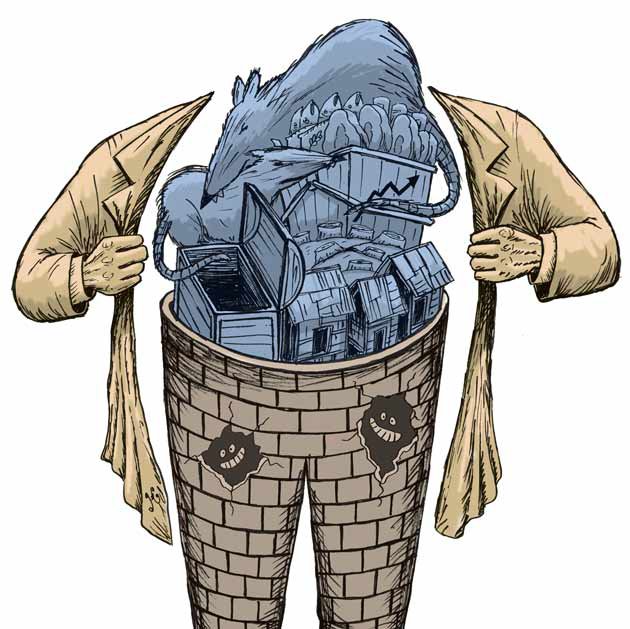
In a
completely open age, we continue to be treated to valueless parodies beyond the
limit of decency. Figures with moral defects walk calmly to the political stage
and fill public offices. Law enforcers have repeatedly been arrested while
trading justice. Their "Majesty" swap the oath of office for money.
Many state institutions mortgage honor and turn into lackeys of crime.
We
suffer from a crisis of dignity when the plague to become powerful and
voracious enters a symbiosis with evil and destructive elements. The values of
nobility and virtue turn their back on authority and mandate. The desire to
dominate belief covered with fanaticism is used to spread hatred, intimidate,
rip through unity and split the public into two diametric poles: Lovers and
haters.
Various
reasons for the moral crisis and civility can be traced back to the nation's
long absence from a learning process. The philosophy and practice of education
are frail and overly large to form the nation's character, thereby leading to a
mentality that is mushy, pragmatic, rowdy and likes bypasses. The failure to
manifest the noble religious message makes the light of divinity and the
embodiment of love fade. Consequently, the reality of daily social life is
smeared with hatred, suspicion, anger, despair, destructive characters and
depravity (Gary Zukaf, 1990: Seat of the Soul).
We are
also vulnerable and often superficially hit by issues of the indigenous and
non-indigenous. National Hero Rear Admiral John Lie (1911-1998) gave a
straightforward definition: "The indigenous are people who clearly defend
the interests of the state and the nation, while the non-indigenous are those
who engage in corruption, extortion, blackmail and subversion."
Education
and culture should be the roots of civilization, an absolute requirement for
the proliferation of progress and the greatness of common sense. Education that
is liberating, affirming the reasoning, developing skepticism, nourishing
expression and imagination. Glorifying the process of "becoming human
beings", based on the mastery of science, social affairs and culture. This
is not just a matter of curriculum, accreditation, certification and other
"clutter".
Education
and quality research bring forth abundant creation and innovation. A number of
countries, such Israel, the United States, China and South Korea, persistently
sow the seeds of excellence to win the future through discoveries and the
registration of thousands of patents, from startup businesses to the possession
of advanced technology. Meanwhile, we are increasingly descending to become a
nation of consumers.
Mental Revolution
Modern
history provides clear evidence of how nations fundamentally transform
themselves to achieve greatness. The West started with the Renaissance, Japan
through the Meiji Restoration, China introduced the Cultural Revolution and
continued with market socialism, South Korea raised the spirit of the Han River
with the target of outperforming Japan, the country it was occupied by. In
short, all originated from efforts to embody the strength of brain-characters,
the superiority of reason for the sake of glorifying the dignity of the nation.
South Korean President Park Chung-hee in 1992 whipped up the spirit of his
people after his country was devastated in a civil war. "Even though we
cannot achieve it on our lifetime, let's work hard for the sake of our
grandchildren, so that they can live prosperously as those in other parts of
the world."
That is
an important lesson; no progress is obtained and achieved in a short time.
There should be a "point of departure "that becomes a joint consensus
and determination. President Jokowi has rolled out the Mental Revolution since
the beginning of his administration. Unfortunately, the operational framework
and the determination to guide the dissemination of the paradigm and mindset
has not yet been sufficient to produce change. It needs authentic proof and
significant change first in the scope of government bureaucracy.
One
clue can be deducted from the suboptimal launch of the 12 economic deregulation
packages to stimulate activity and growth. There are still barriers in the form
of a lack of coordination between ministries and agencies at the central
government and between the central and regional governments. Also, overlapping
regulations continue toobstruct the realization of programs. The classic problems
await radical solutions and the availability of leaders who are qualified to
unravel the deadlock.
Historic task
When he
decided to put his name forward as a US presidential candidate in 1959, John F
Kennedy delivered a speech to launch the New Frontier to welcome future
challenges he considered "not yet known and mapped". He invited the
American people, the baby boomer generation that had not experienced war and
economic hardship, to continue the legacy of tasks from previous presidents, namely
the New Freedom of Woodrow Wilson and the New Deal of Franklin D Roosevelt.
Thirty
years before Kennedy's speech, Bung Karno called on intellectuals of the
Archipelago to be united in guiding the people to achieve independence, banish
colonialism and imperialism. "Across the golden bridge of independence, we
can freely organize the independent society of Indonesia which is solid,
strong, healthy, eternal, and immutable." (Indonesia Sues, August 18,
1930).
He
repeatedly reminded people to be aware of the danger of colonialism in a new
guise, namely collaboration with the elite, destroying the sovereignty of the
people and the livelihoods of the nation. "My struggle is easy, because it
is about repelling invaders, but yours will be more difficult, because you have
to stand against your own people."The historic tasks for the next
generation had been mapped by the founding father of the republic, namely
ensuring the growth of the people's intelligence and the laying of solid ground
to ensure the equitable redistribution of welfare. The two require growth and a
sustainable strengthening of national capacity. This is the pillar, a generic
prescription for a progress-hunting nation.
The
strengthening of national capacity requires the creation of a level playing
field that is fair at all levels of education and business. Quality education
and the development of entrepreneurial character must be comprehended as human
capital investment, so that opposing cost considerations become less relevant.
The cost of higher education and the lack of research limit the ability of the
nation to get out of backwardness.
Welfare
will only grow strong and large and spread on the basis of a chance for many
economic actors to take part. The fact is, all developed countries with stable
politics have a similar character: the majority of the population is
productive, intelligent and equal. Inequality, poverty and unemployment will
continue to haunt us if the state fails to establish an equitable basis for
"hotspots" of growth. Pragmatism in engineering the economic slowdown
will hardly achieve lasting progress.
The
conjuncture of the world economy is filled with uncertainty, especially after
Brexit. Given its scale and integration into the global market (quoting Joseph
Stiglitz, 1998), our economy is like a small boat that sails across the ocean
with great tides. The best defense is to foster and strengthen the structure of
independence, so as not to continuously suffer from being engulfed by the storm
of crisis.
During
previous regimes, various policies and the choice of strategic development
increasingly pushed back the sovereignty and independence of the nation.
The
striking deficit of socio-economic balance in the form of the deterioration of
the nation's character, injustice and destruction of natural resources, is more
than enough valuable learning material for the authorities to proclaim a great
vision and execute substantial policy.
by Suwidi Tono
source Kompas, Tuesday,
July 5, 2016
Indonesian version can be read here

